Evidence Guide · Q Healthy Spa
The Benefits of Massage Therapy, Graded by Evidence
What Holds Up, What Is Modest, and What Is Marketing
Massage therapy is manual manipulation of soft tissue — muscle, fascia and skin — using pressure, gliding strokes and movement. Most people book a 60 minute or 90 minute session because it feels good and their back hurts, which is a perfectly good reason. The question this page answers is which of the other claims survive contact with the research.
Our sources are the National Center for Complementary and Integrative Health, the federal agency that studies practices like this, and Mayo Clinic. Where they are positive we say so. Where they hedge we hedge, and where a common claim has nothing behind it we say that too. Written by certified therapists at a spa that sells massage — which is exactly why the grading matters.
What You Should Know
Muscle Tension Is the Strong Claim
Easing tight, sore, overworked muscle is what massage is actually for, and it is where the evidence and thousands of years of practice agree. Everything else on this page is secondary to that.
The Relaxation Response Is Real
Slower breathing, lower heart rate, dropping muscle tension. It is a measurable physiological state and massage is a reliable way in. It is also temporary, which is why cadence beats intensity.
Pain Relief Is Modest and Temporary
NCCIH finds massage may help some people with low-back, neck and some chronic pain, with small to moderate effects that often fade within weeks. That is a real benefit, honestly sized.
The Toxin Claim Is False
Your liver and kidneys handle clearance. No massage stroke, cup or tool moves toxins out of the body, and no research supports it. Anyone telling you otherwise is telling you things that are not true.
It Is Low Risk for Most Adults
Which matters. A practice with modest benefits and very low risk is a reasonable thing to do regularly. Blood thinners, bleeding disorders, fresh injuries and some pregnancy considerations are the exceptions.
It Sits Alongside Care, Not Instead
For an actual injury, persistent pain or illness, a medical provider comes first. Massage is a good companion to that and a bad substitute for it. We will say so when it matters.
Who This Is For
- Anyone deciding whether regular massage is worth the money
- People who have been told massage will detox them and were suspicious
- Guests choosing between massage and something with stronger evidence
- Anyone under medical care wondering whether massage fits alongside it
- People weighing frequency — weekly, monthly, or only when it hurts
- Readers who would rather have the graded version than the sales version
| Claim | Evidence | Honest summary |
|---|---|---|
| Eases muscle tension and soreness | Good | The core of what it does |
| Produces the relaxation response | Good | Measurable, reliable, short-lived |
| Helps stress | Reasonable | Modest, and study quality varies |
| Helps low-back pain | Reasonable | Small to moderate, often temporary |
| Helps neck pain | Reasonable | Similar picture to low back |
| Helps some chronic pain | Mixed | Some people, some conditions |
| Improves sleep | Weak to modest | Supports habits, doesn't replace them |
| Reduces anxiety symptoms | Weak to modest | Not a treatment for a disorder |
| Boosts immune function | Very weak | We don't claim it |
| Flushes toxins from the body | None | No mechanism. Not true |
| Breaks up scar tissue | None | Overstated everywhere |
| Realigns the spine | None | That is not what hands do |
What massage is, mechanically
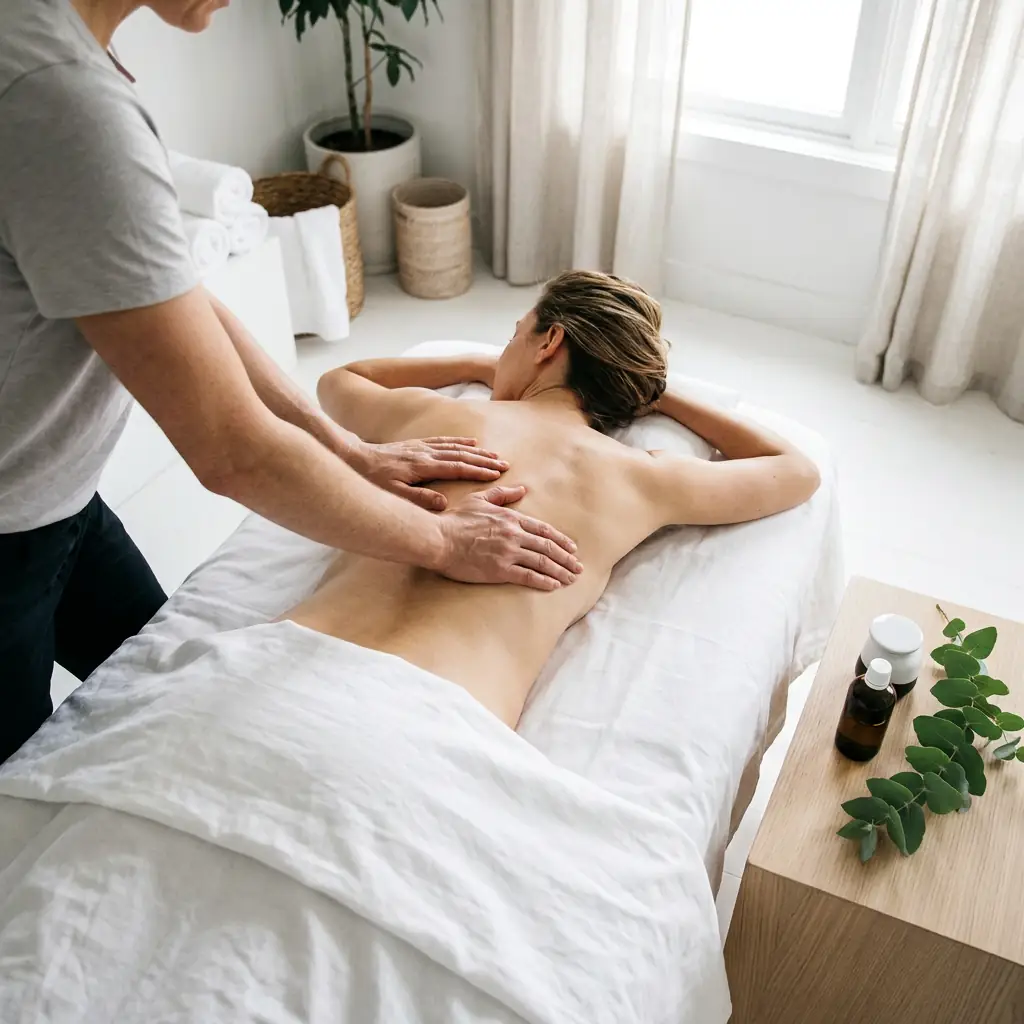
A therapist applies pressure and movement to soft tissue. Muscle that has shortened and stayed short gets lengthened, fascia that has stopped gliding gets mobilised, and the guarding pattern that builds around a sore area gets interrupted. Blood flow to the worked area increases while it is being worked.
That is the whole mechanism, and it is enough to explain the benefits that hold up. Notice what it does not explain: nothing in that list moves a vertebra, dissolves scar tissue or filters your blood.
Why the effects are short-lived
Tissue adapts to what you do with it most of the time. An hour of skilled hands-on work against 40 hours of sitting is a real intervention but not a permanent one — which is why guests typically report 2 to 10 days of noticeable easing rather than weeks.
This is the single most useful thing to understand before deciding whether massage is worth it. The value is in repetition at a sustainable interval, not in one heroic 2 hour booking. Most people settle on every 2 to 4 weeks.
Pressure is not the same as effectiveness
Harder is not better. Pressure you brace against makes you tense up, which works directly against the goal. The right pressure is firm enough to feel like something is happening and light enough that you can breathe normally through it.
This matters because a lot of people assume a massage that did not hurt was not working. Swedish at moderate pressure and deep tissue at firm pressure are different tools for different jobs, not a beginner and an advanced version of the same thing.
The claims that hold up
Three things are on solid enough ground to say plainly. First, massage eases muscular tension and soreness — this is the core use and nobody seriously disputes it. Second, it reliably produces the relaxation response, a measurable physiological state. Third, it is low risk for generally healthy adults.
NCCIH's overview of massage therapy is the reference we lean on. It is a careful document: supportive where the research supports, hedged where it does not, and free of the language you find on spa websites.
| Benefit | Onset | Typical duration |
|---|---|---|
| Muscle tension easing | Same session | 2 to 10 days |
| Relaxation response | 10 to 20 min in | Hours to 1 day |
| Reduced soreness | 24 to 48 hours | 3 to 7 days |
| Improved range of motion | Same session | 2 to 14 days |
| Better sleep that night | Same night | 1 to 2 nights |
| Lower perceived stress | Same session | 1 to 5 days |
The claims that are real but modest
Pain relief is where most people arrive, and it is where honest grading matters most. NCCIH's material on low-back pain and on chronic pain finds massage may help some people, with effects generally described as small to moderate and often fading within weeks.
Read positively, that puts massage among the better-supported non-drug options for ordinary muscular back and neck pain, with very little risk attached. Read plainly, it is not a treatment, and if a studio tells you 6 sessions will fix a disc problem, they are selling something.
Stress and sleep
NCCIH's relaxation techniques material concludes these approaches can help with stress and may help some people sleep better, while noting that study quality varies and effects are modest. Mayo Clinic's sleep guidance points the same way: consistent bed and wake times, a dark cool room, regular activity and 30 to 60 minutes without screens do the heavy lifting.
So massage supports sleep rather than producing it. That is still worth something — an hour with no phone and nothing to decide is genuinely restorative — but it is a wind-down practice, not a treatment for insomnia.
Anxiety and mood
Many guests report feeling calmer and lighter for a few days after a session, and that experience is real. What the research does not support is massage as a treatment for a diagnosed anxiety disorder or depression, where interventions with far stronger evidence exist.
If low mood or anxiety is interfering with your work or relationships, talk to a clinician. Book the massage too if you want; just do not let it stand in for care that would actually help.
The claims that do not hold up
Four claims turn up constantly on spa websites and none of them survive scrutiny. We do not make them, and a provider who does is telling you things they cannot support.
| Claim | Why not |
|---|---|
| Massage flushes toxins | No mechanism. The liver and kidneys clear the body |
| Drink water to flush the toxins out | Hydration is good. The premise is wrong |
| It breaks up scar tissue | Mature scar tissue does not break under hands |
| It realigns the spine | Manual soft-tissue work does not move vertebrae |
| It boosts your immune system | Evidence is very weak; we don't claim it |
| Cupping detoxes you | Marks are pooled blood, not toxins |
| It cures a diagnosed condition | Not a treatment for any condition |
Deciding whether it is worth it for you
Here is the honest calculus. Massage delivers a reliable, modest, temporary benefit at very low risk, and it feels good. If your problem is ordinary muscular tension, stress, or wanting an hour of nothing, that is a good trade. If your problem is a diagnosis, it is not.
The frequency question follows from the duration numbers above. If relief lasts 2 to 10 days, monthly sessions give you a good week each month and weekly sessions give you most of the month. Neither is wrong; pick the one your budget sustains without resentment.
| Goal | Length | Interval | Relief usually lasts |
|---|---|---|---|
| General wellness | 60 minutes | Every 4 weeks | 2 to 10 days |
| Desk-job neck and shoulders | 60 minutes | Every 2 to 3 weeks | 2 to 7 days |
| Chronic tightness | 90 minutes | Every 2 weeks | 3 to 10 days |
| Sleep and stress | 60 minutes | Every 2 to 4 weeks | 1 to 5 days |
| Range of motion | 90 minutes | Every 2 to 4 weeks | 2 to 14 days |
| Soreness after hard training | 60 minutes | Within 24 to 48 hours | 3 to 7 days |
| Your first massage ever | 60 minutes | Once, then decide | 2 to 10 days |
| An unhurried full body session | 120 minutes | Every 4 weeks | 2 to 10 days |
Choosing a style
Swedish for relaxation and general tension. Deep tissue for knots and chronic tightness. Futon floor-mat for hips, stretching and range of motion. Cupping or gua sha as add-ons for spots that resist hands alone, offered as traditional comfort practices rather than treatments.
If you are new to all of it, the first-time guide covers what actually happens on the table, and first visits at Q Healthy Spa are $5 off.
When to skip it
Skip or get clearance for a fresh injury from the last few days, an active infection, a fever, blood thinners or a bleeding disorder, a deep vein thrombosis, or any new and severe symptom. Tell your therapist about medications, pregnancy and skin conditions at intake.
And see a medical provider first for numbness, weakness, radiating pain, unexplained weight loss, or pain that consistently wakes you at night. Massage should never be the reason a diagnosis was delayed.
How we use this at Q Healthy Spa
Practically, it means we will tell you when 90 minutes is a better booking than 60, and when a doctor is a better booking than either. It means our cupping pages cite the NCCIH fact sheet that declines to list a single condition cupping treats. And it means nobody here will tell you that your session flushed anything.
We are at 2151 Eastridge Center, Floor 1, #C, Eau Claire, WI 54701, open 9:00 AM to 9:30 PM all 7 days, rated 5.0 stars across 16 Google reviews. Every session includes complimentary hot stone therapy and sauna access, and first visits are $5 off. Call 715-256-8288.
How to Book a Massage at Q Healthy Spa
Booking takes about 2 minutes and there is no online form to fill in. Call 715-256-8288 any day between 9:00 AM and 9:30 PM, say which service and length you want, and the session is held under your first name. Walk-ins are taken when a table is free, which on weekday afternoons is most of the time.
- Call 715-256-8288. Someone answers the phone during all 12.5 open hours, 7 days a week — there is no booking app and no deposit.
- Pick a length: 60 minutes for a full body session, 90 minutes for unhurried work on the back and shoulders, or 120 minutes when you want both.
- Pick a pressure: light, medium, or firm. You can change it mid-session at any point, and saying so does not offend anyone.
- Mention add-ons at booking. Cupping and gua sha are added to a 60 or 90 minute session and need a few extra minutes set aside.
- Arrive 5 to 10 minutes early at 2151 Eastridge Center, Floor 1, Suite C. Parking is free and the entrance is on the ground floor.
- Tell the therapist what hurts and what to avoid before the session starts. This 60-second conversation is what makes the other 59 minutes useful.
- Pay by cash or card at the end. First-time visitors get $5 off, and no appointment is needed to claim it.
| Detail | Number | Notes |
|---|---|---|
| Days open per week | 7 | Including most holidays |
| Hours open per day | 12.5 | 9:00 AM to 9:30 PM |
| Last session start | 8:30 PM | For a 60 minute session |
| Session lengths | 60, 90, 120 minutes | Same 4 styles at every length |
| Massage styles | 4 | Futon, Swedish, deep tissue, therapeutic |
| Add-ons available | 2 | Cupping and gua sha, inside a 60 or 90 minute session |
| First-visit discount | $5 | Every new client, no coupon needed |
| Included at no extra charge | 2 | Hot stone therapy and sauna access |
| Google rating | 5.0 stars | 16 reviews |
| Assisted stretches in a futon session | 15 to 25 | Fully clothed, no oil |
| Cupping marks fade in | 3 to 7 days | Dry cupping only, never wet |
| Arrive before your session | 10 minutes | 5 minute intake, 3 to 5 to change |
| Drive from downtown Eau Claire | 7 minutes | 2.5 miles |
| Drive from Chippewa Falls | 15 minutes | 11 miles via Highway 124 |
| Notice for a Saturday booking | 3 to 7 days | Weekday mornings often same day |
Sources
- NCCIH — Massage Therapy: What You Need To KnowThe federal complementary-health agency's overview of what massage is and what the research does and does not support.
- NCCIH — Chronic Pain and Complementary Health ApproachesReviews the evidence for massage and related approaches in chronic pain, including where results are modest.
- NCCIH — Relaxation Techniques: What You Need To KnowCovers the relaxation response, sleep and stress, and how the evidence is graded.
Frequently Asked Questions
What are the proven benefits of massage therapy?
Three hold up well: easing muscular tension and soreness, producing the relaxation response (slower breathing, lower heart rate, dropping muscle tension), and doing both at very low risk for generally healthy adults. Beyond that, NCCIH finds massage may help some people with low-back pain, neck pain and some chronic pain, with effects generally small to moderate and often fading within weeks.
Does massage remove toxins from your body?
No. There is no mechanism by which massage moves toxins out of the body — your liver and kidneys handle clearance. The advice to drink water afterward is fine on its own terms, but the reasoning usually given for it is wrong. Any provider making the toxin claim is telling you something they cannot support.
How long do the benefits last?
Guests typically report 2 to 10 days of noticeable easing in muscle tension, 2 to 14 days of improved range of motion, and hours to a day of the relaxation effect. Tissue adapts to what you do most of the time, so one hour against a week of sitting is a real but temporary intervention. That is why cadence matters more than intensity.
How often should I get a massage?
Every 2 to 4 weeks is where most people settle. If relief lasts 2 to 10 days, monthly sessions buy you a good week each month and weekly sessions cover most of it. For a specific issue, weekly or fortnightly for the first month then spacing out works better than one long booking. Pick the interval your budget sustains without resentment.
Can massage replace physical therapy or medical care?
No. Massage sits alongside medical care and is a poor substitute for it. See a provider first for a fresh injury, persistent or worsening pain, numbness, weakness, radiating pain, unexplained weight loss, or pain that wakes you at night. Once you know what you are dealing with, massage alongside that care is low-risk and often helpful.
Does massage help you sleep?
It may help on the night of a session, and the evidence for relaxation approaches supporting sleep is real but modest and uneven. What does the heavy lifting is the unglamorous stuff Mayo Clinic lists — consistent bed and wake times, a dark cool room, regular activity, and 30 to 60 minutes without screens before bed. Massage is a wind-down practice, not a treatment for insomnia.
Is deeper pressure more effective?
No. Pressure you brace against makes you tense up, which works against the goal. The right pressure is firm enough to feel like something is happening and light enough that you can breathe normally. Swedish and deep tissue are different tools for different jobs, not beginner and advanced versions of the same thing.
Who should not get a massage?
Get clearance or skip it if you have a fresh injury from the last few days, an active infection or fever, a bleeding or clotting disorder, are on blood thinners, or have a suspected deep vein thrombosis. Tell your therapist about all medications, pregnancy and skin conditions at intake — it changes what is appropriate, particularly for add-ons like cupping.
Book a Session on Honest Terms
Modest, temporary, low-risk and genuinely pleasant — that is the real offer, and it is a good one. Open 9:00 AM to 9:30 PM every day, $5 off your first visit. Call 715-256-8288.
Keep Reading
Every page below covers a different angle — technique, pairing, evidence, or the rest of the menu at Q Healthy Spa.