Cupping Guide · Eau Claire, WI
The Best Cupping Guide for Eau Claire, WI
Expert Professional Answers — What Cupping Is, What the Marks Are, and What the Evidence Says
The marks are the whole story. A swimmer climbs out of the pool with a row of dark purple circles down his shoulders, the photo goes everywhere, and cupping gets described as ancient, powerful, detoxifying and proven. Then you look at what the federal agency built to study practices like this actually publishes about it, and the benefits section is essentially missing.
This is the version of the cupping conversation we would want handed to us: what cupping is, why it leaves circles, how it differs from gua sha, what the published research does and does not support, what the real risks are, and how to tell a careful provider from a careless one. Written by certified therapists at a spa that offers both — we run cupping inside a 60 minute or 90 minute massage, and we are open until 9:30 PM daily — which is exactly why the honesty matters.
If you already know cupping is for you and want technique, pricing and booking, our cupping therapy page covers all of it. If you want it paired with deep tissue work, that page goes there. This one stays on the basics.
What You Should Know
Suction, Not Pressure
Cupping pulls skin and surface tissue up into a cup. A massage pushes down. That single reversal explains the deep-stretch feeling and the round marks alike.
Dry vs Wet Is the Real Question
Dry cupping never pierces the skin. Wet cupping deliberately cuts it so blood flows into the cup. If a provider cannot tell you plainly which one they do, stop there.
NCCIH Lists No Conditions It Treats
The federal cupping fact sheet cites no trial showing cupping works and names no condition it treats. Most of the page is about safety. That silence is itself a finding.
The Marks Are Pooled Blood
Round patches are blood from tiny ruptured capillaries — the same biology as a bruise, made by negative pressure instead of impact. Not toxins. Not a detox.
The Risks Are Concrete
Documented harms include persistent discoloration, scars, burns, infections, and worsened eczema or psoriasis. Rare severe cases have been reported. These are not hypotheticals.
Ask About Sterilization
Cupping gear can pick up trace blood even in dry cupping. Reusing it between people without sterilizing can transmit hepatitis B and C. Ask the question everywhere you book.
Who This Is For
- Anyone deciding whether to try cupping for the first time
- People weighing cupping against gua sha and unsure which one they want
- People who saw the Olympic photos and want to know what was actually happening
- Guests who want to know what the round marks mean before agreeing to them
- Anyone on medication, pregnant, or with a skin condition weighing the risks
- People comparing cupping providers in Eau Claire and Chippewa Falls
- Readers who would rather have the honest version than the marketing one
| Question | Short answer |
|---|---|
| Conditions NCCIH says cupping treats | 0 — the fact sheet lists none |
| Trials cited showing it works | 0 |
| How long marks typically last | 3–7 days |
| What the marks are | Pooled blood from ruptured surface vessels |
| Dry vs wet cupping | Dry never pierces skin; wet cuts it. We do dry only |
| Documented side effects | Discoloration, scars, burns, infection, eczema flares |
| Rest after a session | 24 hours before sauna or hard training |
| Book ahead of photos | 7–10 days |
| Q Healthy Spa hours | 9:00 AM – 9:30 PM, 7 days a week |
| Phone | 715-256-8288 |
| Google rating | 5.0 across 16 reviews |
| Address | 2151 Eastridge Center Floor 1, #C, Eau Claire, WI 54701 |
What cupping is
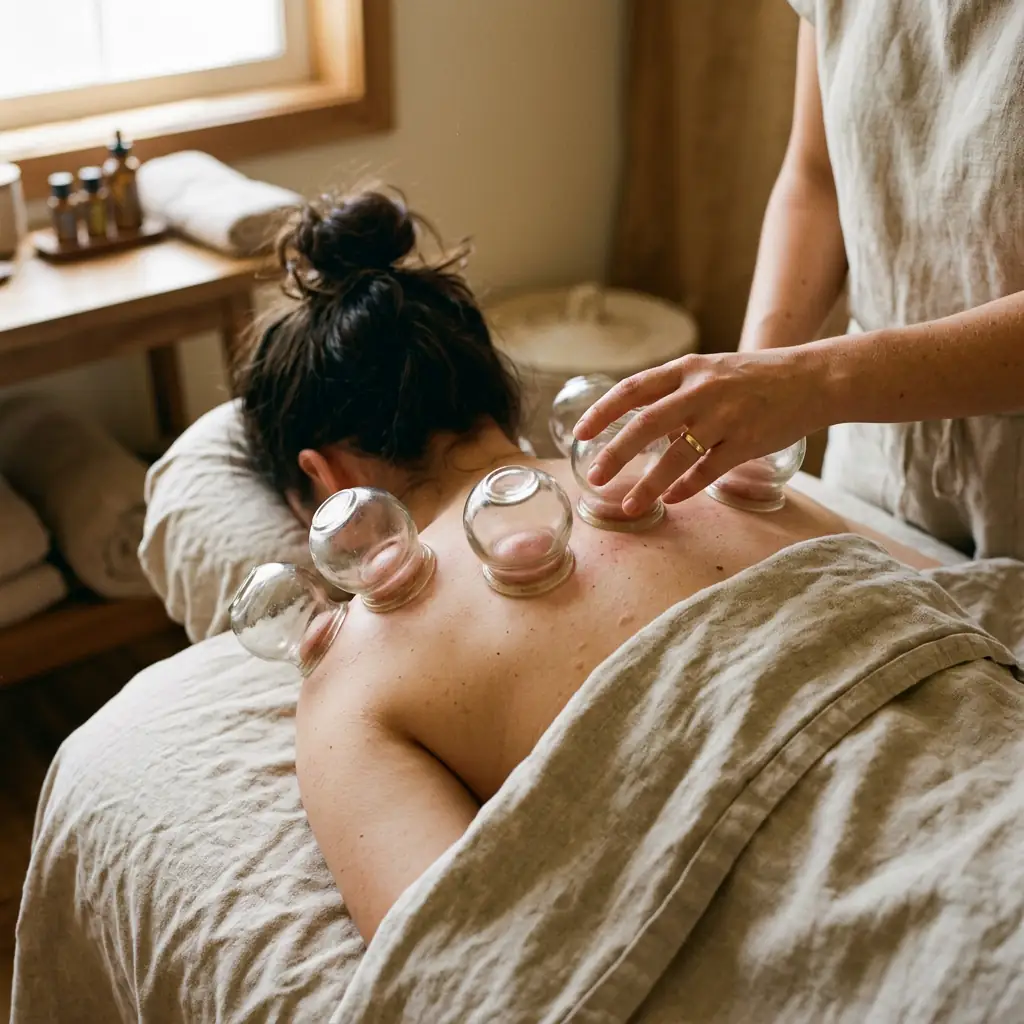
Cupping is a practice used in traditional medicine in several parts of the world, including China and the Middle East. A practitioner places a cup on your skin and creates suction inside it. The negative pressure lifts the skin and the surface tissue underneath up into the cup, and that lift is the entire technique.
Everything people argue about with cupping traces back to that one mechanical fact. Understand the pull and the rest of the practice stops being mysterious.
| Question | Number | Detail |
|---|---|---|
| Conditions NCCIH says cupping treats | 0 | The federal fact sheet lists none |
| Trials NCCIH cites showing it works | 0 | Most of the page is safety |
| How long marks last | 3 to 7 days | Darkest at 24 to 48 hours |
| Gua sha marks, by comparison | 2 to 5 days | Streaks rather than round patches |
| Session lengths cupping rides inside | 60 or 90 minutes | Never sold as 10 minutes of suction |
| Warm-up by hand before cups go on | 10 to 15 minutes | On the same tissue |
| Rest before sauna or hard training | 24 hours | After any cupping session |
| Water in the first 2 hours after | 16 to 20 oz | Skip alcohol |
| Book ahead of photos or an event | 7 to 10 days | Or ask to stay off visible areas |
| Wet cupping sessions performed here | 0 | Dry, non-piercing only |
| Scalp cupping sessions performed here | 0 | At any pressure, for anyone |
| Studio hours | 9:00 AM to 9:30 PM | 7 days a week, 12.5 hours a day |
| Last session start | 8:30 PM | For a 60 minute booking |
| First-visit discount | $5 | Applies with cupping added |
| Drive from Chippewa Falls | 15 minutes | 11 miles via Highway 124 |
| Drive from downtown Eau Claire | 7 minutes | 2.5 miles |
| Arrive before your session | 10 minutes | 5 minute intake, 3 to 5 to change |
How the suction is created
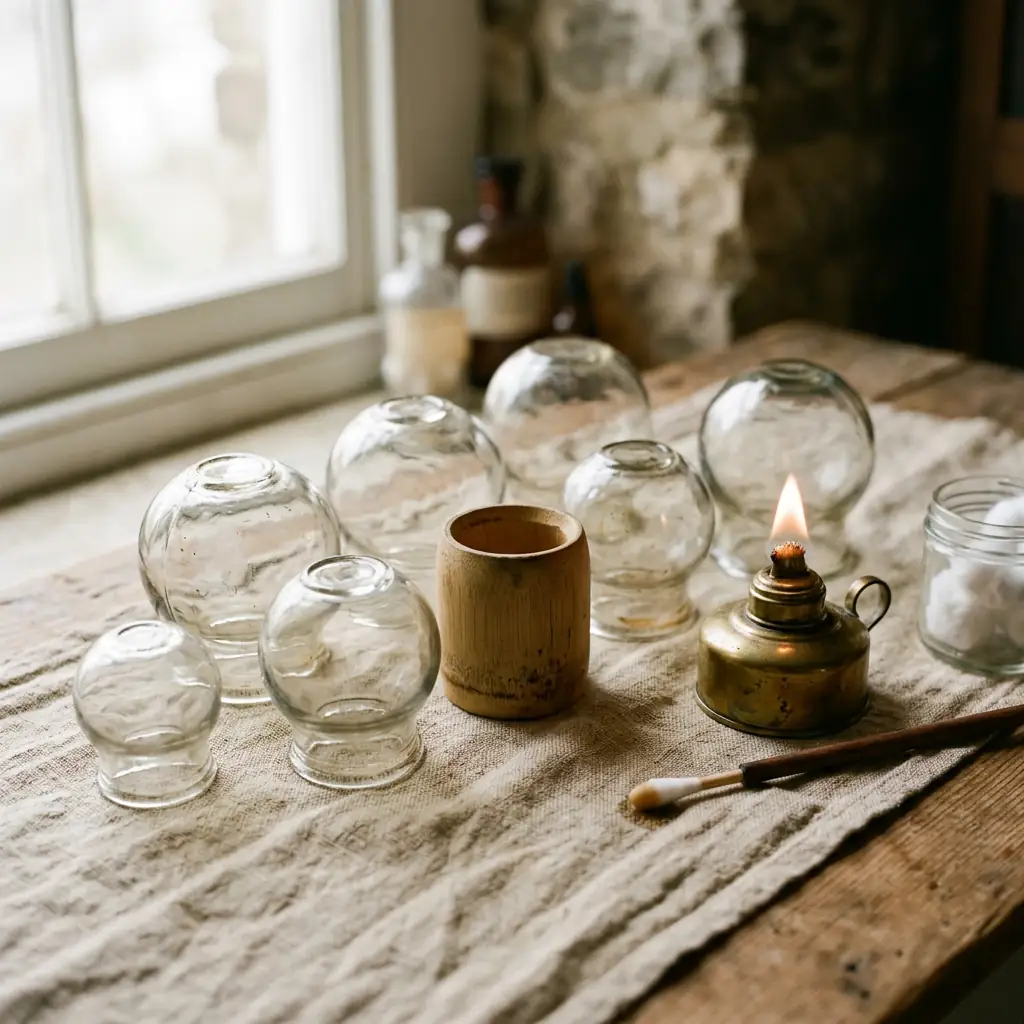
The older method applies a flame to the cup to burn off oxygen, then presses the cup to the skin; as the trapped air cools and contracts, the pressure drops and tissue is drawn upward. The newer and far more common method skips the fire and simply draws the air out mechanically once the cup is in place.
The distinction is not academic. Burns appear on NCCIH's list of documented cupping side effects, and they trace straight back to the fire method: an open flame near skin to create suction carries an obvious hazard. Flameless suction removes that hazard entirely, which is worth asking about wherever you book.
It pulls; a massage pushes
A massage therapist presses down into tissue, compressing it against the structures beneath. Cupping does the reverse, lifting tissue away from them. That is why people describe cupping as a deep stretch from the inside or a steady tug rather than as pressure.
It is also why cupping draws blood toward the surface — which is the part everyone is actually curious about, and the subject of the next two sections.
Dry versus wet cupping: one breaks the skin, one doesn't
The most important distinction in cupping is whether the skin stays intact, and NCCIH draws the line in a single sentence: in wet cupping the skin is pierced and blood flows into the cup; dry cupping does not involve piercing the skin.
That gap is bigger than the names suggest. Dry cupping leaves a bruise. Wet cupping is, by design, a procedure that opens the skin and deliberately draws blood, which moves the risk from discoloration to open wound — and, with repetition, to anemia from blood loss, which has been reported. These are not the same conversation, and they should not be booked under the same word without a clear answer.
Q Healthy Spa performs dry, non-piercing cupping only. Wherever you book, ask which one they do before anything else.
The marks, day by day
Most people judge their marks on day 1, which is the worst possible day to judge them. The pattern below is what a typical set looks like over a week — darkest at 24 to 48 hours, then fading steadily with no treatment at all.
| Time after session | Colour | Tender? | Visible in a t-shirt? |
|---|---|---|---|
| 0 to 2 hours | Pink to light red | Rarely | Sometimes |
| 2 to 12 hours | Red deepening | Rarely | Sometimes |
| 24 to 48 hours | Darkest — red to purple | Occasionally | Sometimes |
| Day 3 | Purple fading to brown | No | Rarely |
| Day 4 to 5 | Brown to yellow-green | No | No |
| Day 6 to 7 | Faint yellow or gone | No | No |
| Beyond 10 days | Should be gone | No | No |
Why you get the circles
The marks are not bruises from impact, and they are not toxins being pulled to the surface, whatever the marketing says. Suction inside the cup ruptures tiny blood vessels just under the skin, and blood leaks into the surrounding tissue. The result is a flat, round patch of discoloration — red, purple, sometimes nearly black — tracing the rim of the cup. Same biology as a bruise, produced by negative pressure instead of a blow.
There is no mechanism for a detox
A cup cannot draw anything through intact skin. Your liver and kidneys handle clearance in your body; suction on your back does not participate in it. NCCIH describes cupping marks as temporary discoloration, not as a detox event, and no research supports the toxins claim that gets repeated so confidently.
This matters practically, not just semantically. A provider willing to tell you the marks are toxins is a provider willing to tell you things that are not true, and you have no way to know where that stops.
Tell your clinician where the marks came from
NCCIH makes one practical point about the marks that is easy to overlook: their origin should be explained to your health care providers, so round symmetrical patches are not mistaken for signs of physical abuse. That is not hypothetical. A clinician who sees rows of circular marks on someone's back with no context has good reason to ask hard questions.
Mention the cupping up front and you spare everyone the detour.
How long they last
Most cupping marks fade in 3 to 7 days and need no treatment. But NCCIH also lists persistent skin discoloration and scarring among documented side effects, which cuts against the idea that the marks are always harmless and always brief. Moderate suction, healthy skin and a therapist who checks in during the session all reduce that risk.
Cupping vs gua sha vs massage — side by side
Three modalities, three different mechanics, three different mark patterns. The table below is the short version; the sections that follow explain each column.
| Cupping | Gua sha | Deep tissue | |
|---|---|---|---|
| Direction of force | Lifts up | Pushes across | Presses down |
| Typical add-on time | 15 to 30 min | 10 to 20 min | Whole session |
| Marks | Round patches | Streaks | None usually |
| Marks fade in | 3 to 7 days | 2 to 5 days | 0 days |
| Works on flat areas | Yes | Yes | Yes |
| Works on neck / shins | No, poor seal | Yes | Yes |
| Conditions NCCIH says it treats | 0 | 0 | 0 claimed here |
| Rest before hard training | 24 hours | 24 hours | 24 hours |
| Available at Q Healthy Spa | Yes | Yes | Yes, 60 to 120 min |
Cupping vs gua sha: what's the difference?
Gua sha comes up constantly once people start reading about cupping, and the two get confused because they share a tradition, a target and a side effect. Both work the surface tissue rather than pressing deep into it. Both can leave temporary marks. Both are offered here, often in the same session.
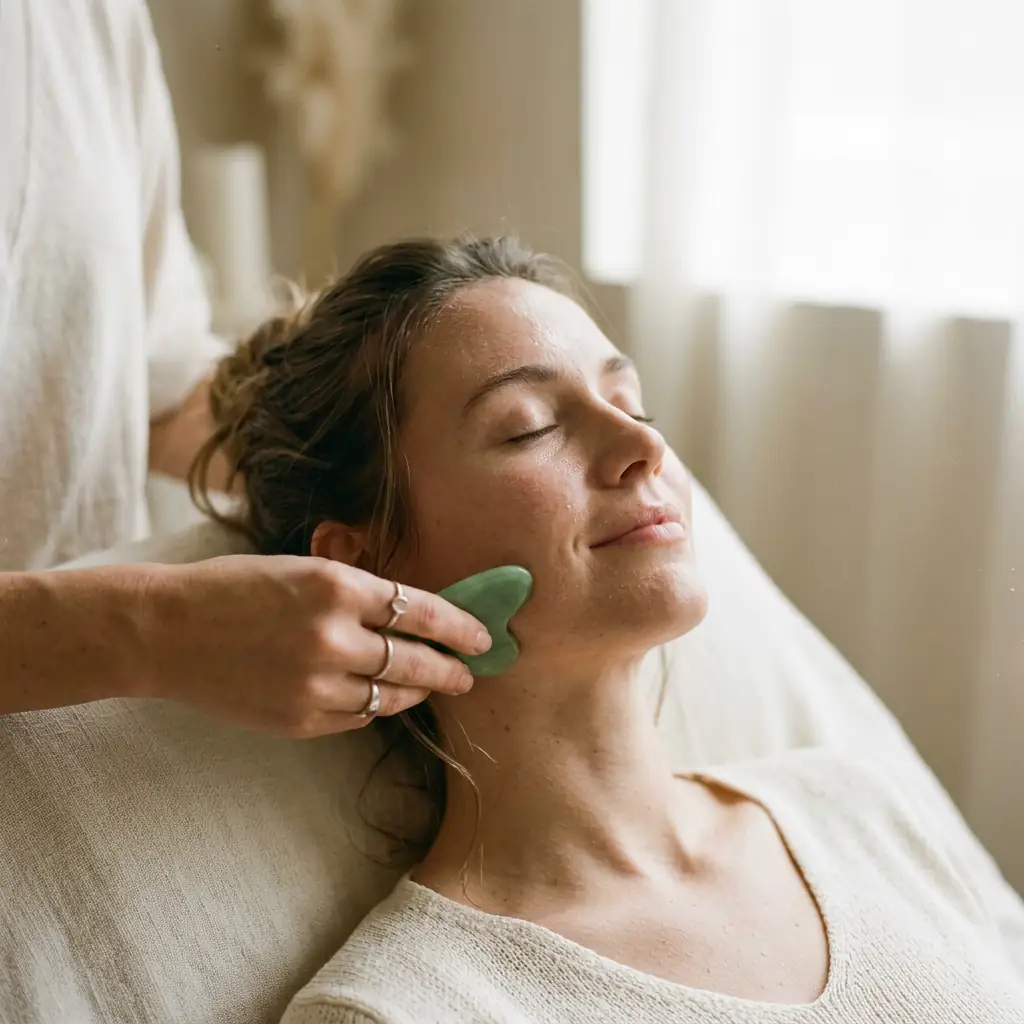
The difference is the direction of the force. Cupping lifts tissue upward with suction. Gua sha does the opposite: a smooth-edged tool is stroked firmly along oiled skin, pushing across the tissue rather than pulling it up. That is the whole distinction, and everything else follows from it.
Where each one fits
A cup needs a seal, which means it needs a broad, reasonably flat, reasonably fleshy surface — the back, the glutes, the thighs. Put one over a collarbone or the side of a neck and it either will not hold or will not be comfortable. Gua sha has no such constraint, so it covers the neck, the shoulder ridge, the forearms, the shins, and anywhere else too bony or too thin for suction.
That is why a session often uses both rather than choosing. Cups on the thick zones, gua sha on the ridges and edges.
The marks differ in shape, not in cause
Cupping leaves round patches tracing the rim of the cup. Gua sha leaves streaks and speckling — sometimes called sha — running along the direction of the strokes. Underneath, both are the same thing: small surface vessels ruptured by mechanical force, with a little blood pooling in the surrounding tissue. Neither is toxins leaving the body, and both usually clear in a few days.
The contraindications are effectively the same too. Blood thinners, bleeding and clotting disorders, fragile or broken or infected skin, active eczema or psoriasis in the area, and fresh injuries all rule out gua sha for the same reasons they rule out cupping.
And the evidence is in the same place
Which is to say: thin. Gua sha has been studied even less than cupping, and it sits inside the same traditional Chinese medicine bucket where NCCIH is consistently cautious. Treat it the way this page treats cupping — a traditional comfort practice people use to feel looser, not a treatment for anything, and never a substitute for medical care.
How to Book a Massage at Q Healthy Spa
Booking takes about 2 minutes and there is no online form to fill in. Call 715-256-8288 any day between 9:00 AM and 9:30 PM, say which service and length you want, and the session is held under your first name. Walk-ins are taken when a table is free, which on weekday afternoons is most of the time.
- Call 715-256-8288. Someone answers the phone during all 12.5 open hours, 7 days a week — there is no booking app and no deposit.
- Pick a length: 60 minutes for a full body session, 90 minutes for unhurried work on the back and shoulders, or 120 minutes when you want both.
- Pick a pressure: light, medium, or firm. You can change it mid-session at any point, and saying so does not offend anyone.
- Mention add-ons at booking. Cupping and gua sha are added to a 60 or 90 minute session and need a few extra minutes set aside.
- Arrive 5 to 10 minutes early at 2151 Eastridge Center, Floor 1, Suite C. Parking is free and the entrance is on the ground floor.
- Tell the therapist what hurts and what to avoid before the session starts. This 60-second conversation is what makes the other 59 minutes useful.
- Pay by cash or card at the end. First-time visitors get $5 off, and no appointment is needed to claim it.
| Detail | Number | Notes |
|---|---|---|
| Days open per week | 7 | Including most holidays |
| Hours open per day | 12.5 | 9:00 AM to 9:30 PM |
| Last session start | 8:30 PM | For a 60 minute session |
| Session lengths | 60, 90, 120 minutes | Same 4 styles at every length |
| Massage styles | 4 | Futon, Swedish, deep tissue, therapeutic |
| Add-ons available | 2 | Cupping and gua sha, inside a 60 or 90 minute session |
| First-visit discount | $5 | Every new client, no coupon needed |
| Included at no extra charge | 2 | Hot stone therapy and sauna access |
| Google rating | 5.0 stars | 16 reviews |
| Assisted stretches in a futon session | 15 to 25 | Fully clothed, no oil |
| Cupping marks fade in | 3 to 7 days | Dry cupping only, never wet |
| Arrive before your session | 10 minutes | 5 minute intake, 3 to 5 to change |
| Drive from downtown Eau Claire | 7 minutes | 2.5 miles |
| Drive from Chippewa Falls | 15 minutes | 11 miles via Highway 124 |
| Notice for a Saturday booking | 3 to 7 days | Weekday mornings often same day |
Sources
- NCCIH — CuppingThe federal fact sheet on cupping: no conditions it treats, the marks, and the documented safety risks.
- NCCIH — Traditional Chinese Medicine: What You Need To KnowContext for how tai chi, acupuncture and herbal products have fared under modern testing.
- NCCIH — Massage Therapy: What You Need To KnowThe federal complementary-health agency's overview of what massage is and what the research does and does not support.
Frequently Asked Questions
What is cupping therapy, in plain language?
A practitioner places a cup on your skin and creates suction inside it, either mechanically or, in the older method, by briefly heating the cup first. The negative pressure lifts the skin and the tissue just beneath it up into the cup. That pull is the entire technique — it is the reverse of a massage stroke, which presses down instead.
Why does cupping leave circular marks?
The suction ruptures tiny blood vessels just under the skin, and a small amount of blood leaks into the surrounding tissue. What you see is a flat round patch tracing the rim of the cup — the same biology as a bruise, produced by negative pressure rather than impact. It is not toxins; there is no mechanism by which a cup draws anything through intact skin.
How long do cupping marks last?
Usually 3 to 7 days, and they need no treatment to clear. NCCIH does list persistent discoloration and scarring among documented side effects, though, so the marks are not guaranteed to be brief in every case. Moderate suction and healthy skin under the cup both help.
What is the difference between cupping and gua sha?
Direction of force. Cupping uses suction to lift skin and surface tissue up into a cup. Gua sha strokes a smooth-edged tool firmly along oiled skin, pushing across the tissue instead of pulling it up. Cupping leaves round patches; gua sha leaves streaks. Underneath, both marks are the same thing — small surface vessels ruptured by mechanical force, not toxins. A cup needs a broad flat area to seal, so gua sha is what reaches the neck, shoulder ridge, forearms and shins. Q Healthy Spa offers both, often in the same session, and the contraindications and the thin evidence base apply equally to each.
Is cupping proven to work?
No. The NCCIH cupping fact sheet lists no conditions cupping treats and cites no trials showing it works — most of the page is about safety. The honest reading is not that cupping has been disproven but that the high-quality evidence needed to say either way is largely missing. Treat it as a traditional comfort practice, not as a medical treatment.
What is the difference between dry and wet cupping?
In dry cupping the skin is never pierced. In wet cupping the skin is deliberately cut so blood flows into the cup. Wet cupping carries substantially heavier risks — bloodborne infection, scarring, and anemia from blood loss with repetition. Q Healthy Spa performs dry, non-piercing cupping only. Ask any provider which one they do before you book.
What are the actual risks of cupping?
Documented side effects include persistent skin discoloration, scars, burns, infections, and worsening of eczema or psoriasis. Rare severe cases have been reported, including bleeding inside the skull after scalp cupping and anemia after repeated wet cupping. Equipment that is not sterilized between clients can transmit hepatitis B and C — a risk that applies to dry cupping too, since suction alone can leave trace blood on the gear.
Does cupping detox the body?
No. Your liver and kidneys handle clearance; a cup on your skin does not participate in it, and nothing crosses intact skin into a cup. The marks are pooled blood, not extracted toxins. Any provider who tells you otherwise is making a claim with no research behind it.
Should I try cupping if I'm on blood thinners or pregnant?
Not without clearing it with your physician first. Cupping works by rupturing tiny surface vessels, so blood thinners and bleeding or clotting disorders change the risk picture significantly. During pregnancy, some placements are not appropriate. Tell your therapist your medications and conditions at intake, and when in doubt ask your own clinician rather than the spa.
Where can I try cupping in Eau Claire?
Q Healthy Spa offers dry cupping at 2151 Eastridge Center, Floor 1, #C, Eau Claire, WI 54701, open daily 9:00 AM to 9:30 PM. We run it inside a deep tissue or therapeutic massage rather than as standalone suction. Call 715-256-8288 for rates and availability. A handful of other studios in town offer cupping as well — our Eau Claire massage guide covers who does what.
Questions We Didn't Answer Here?
Call and ask. We would rather talk you out of a cupping session you shouldn't have than book it. Open daily 9:00 AM to 9:30 PM in Eau Claire.
Keep Reading
Every page below covers a different angle — technique, pairing, evidence, or the rest of the menu at Q Healthy Spa.