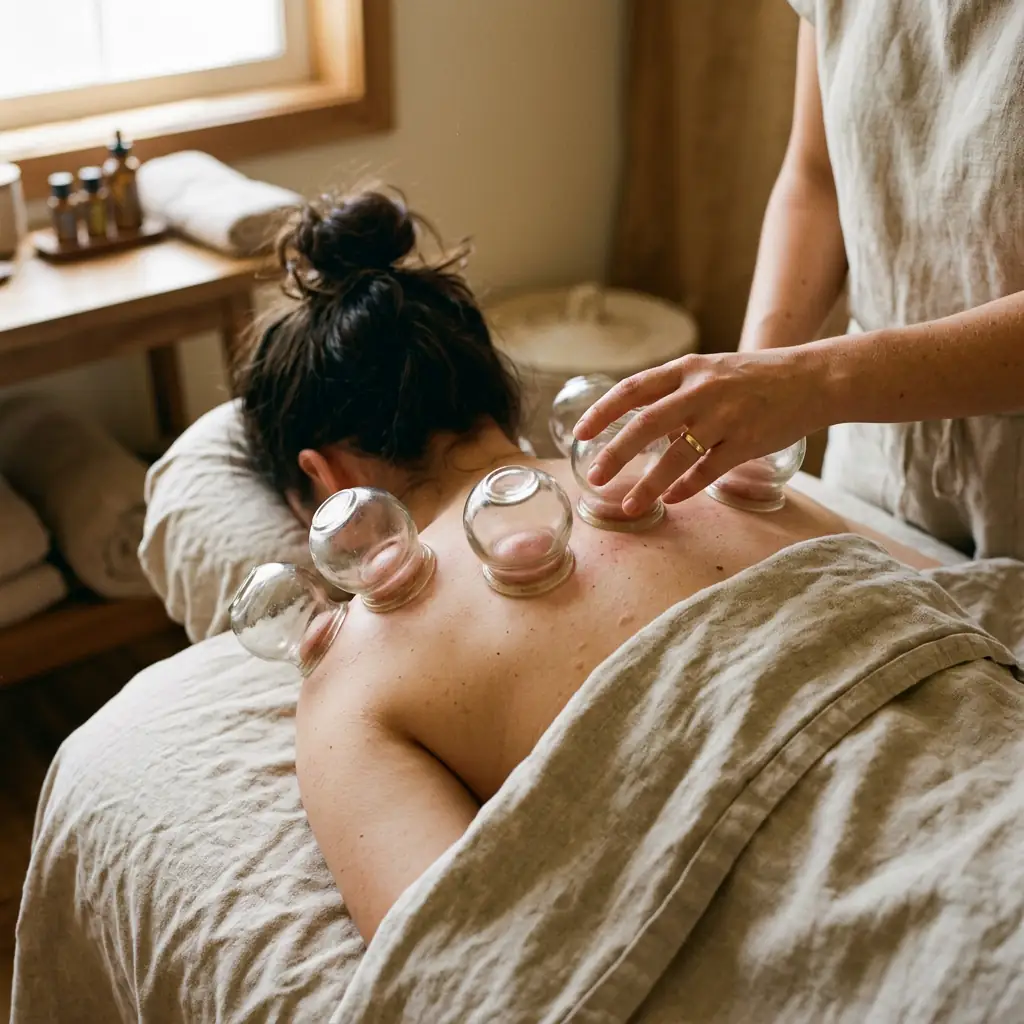
Cupping Therapy · Eau Claire, WI
Best Cupping Therapy in Eau Claire, WI
Expert Professional Dry Cupping, Built Into a Real Massage
Cupping therapy is dry, non-piercing suction cupping: your certified therapist sets a cup on the skin, draws the air out, and the tissue underneath lifts gently into it. At Q Healthy Spa in Eau Claire we run it inside a 60 minute or 90 minute hands-on massage rather than as a ten-minute standalone add-on, because the skilled bodywork is where the stronger benefit sits and the cups are one satisfying step folded into it.
This page is the practical one: what the cups do, how a session actually runs, whether it hurts, what the round marks really are, who should skip cupping entirely, and how to book. If you want the plain-English background first, read the cupping guide. If you already know you want it paired with deep tissue work, the cupping massage page goes deeper on that.
One honest note before you book. Cupping is a traditional comfort practice with thin scientific evidence behind it, not a medical treatment. It complements massage, rest, hydration and sleep — it does not replace any of them, and it does not replace your doctor. We would rather tell you that up front than sell you something we cannot stand behind.
What You Should Know
Dry Cupping Only, Never Wet
Dry cupping does not pierce the skin. Wet cupping cuts the skin to draw blood into the cup — a different procedure with far heavier risks. We do not offer it and never will.
Cups Inside a Real Massage
Most guests add cupping to a 60- or 90-minute deep tissue or therapeutic session. We warm the tissue by hand first, decompress with cups, then come back by hand to integrate.
It Should Not Hurt
You feel a firm pull, like a deep stretch from inside the muscle — not a sharp or burning pain. Suction is dialed to your comfort, and eased or released the moment you say so.
Straight Talk About the Marks
Cupping can leave round pink-to-purple patches. They are pooled blood from tiny ruptured capillaries — the same biology as a bruise, not toxins — and they usually fade in 3 to 7 days.
Gua Sha Available Too
We also offer gua sha — the same tradition, worked with a smooth-edged tool instead of suction. It reaches the neck, shoulder ridge and forearms where a cup seals poorly, and rides in the same appointment.
Free Hot Stone & Sauna
Every session at Q Healthy Spa includes complimentary hot stone therapy and sauna access, and first-time guests get $5 off. The warmth pairs well with a cupping session.
Open Late, Seven Days
We are open daily 9:00 AM to 9:30 PM at 2151 Eastridge Center in Eau Claire, so a cupping session fits after work rather than instead of it. Call 715-256-8288 to check availability.
Who This Is For
- Desk workers carrying weeks of tightness through the upper traps and mid-back
- Runners, lifters and weekend athletes who are sore from training, not injured
- People whose knots do not fully release under hands-on pressure alone
- Anyone curious about cupping who wants a straight answer before the first cup
- Guests already booking deep tissue who want one more tool on the tight spots
- Chippewa Falls and Altoona residents looking for cupping within a short drive
| Detail | What to expect |
|---|---|
| Cup time added to a session | 15–30 minutes of focused work |
| Session lengths available | 60, 90 or 120 minutes |
| Hands-on warm-up before cups | 10–15 minutes |
| How long marks last | 3–7 days, no treatment needed |
| Skip sauna, hot tub, hard training | About 24 hours after |
| Book ahead of a photo or event | 7–10 days |
| Open | 7 days a week, 9:00 AM – 9:30 PM |
| Address | 2151 Eastridge Center Floor 1, #C, Eau Claire, WI 54701 |
| Phone | 715-256-8288 |
| Google rating | 5.0 stars across 16 reviews |
| First-visit discount | $5 off |
| Included with every session | Hot stone therapy + sauna access, $0 extra |
How cupping therapy works at Q Healthy Spa
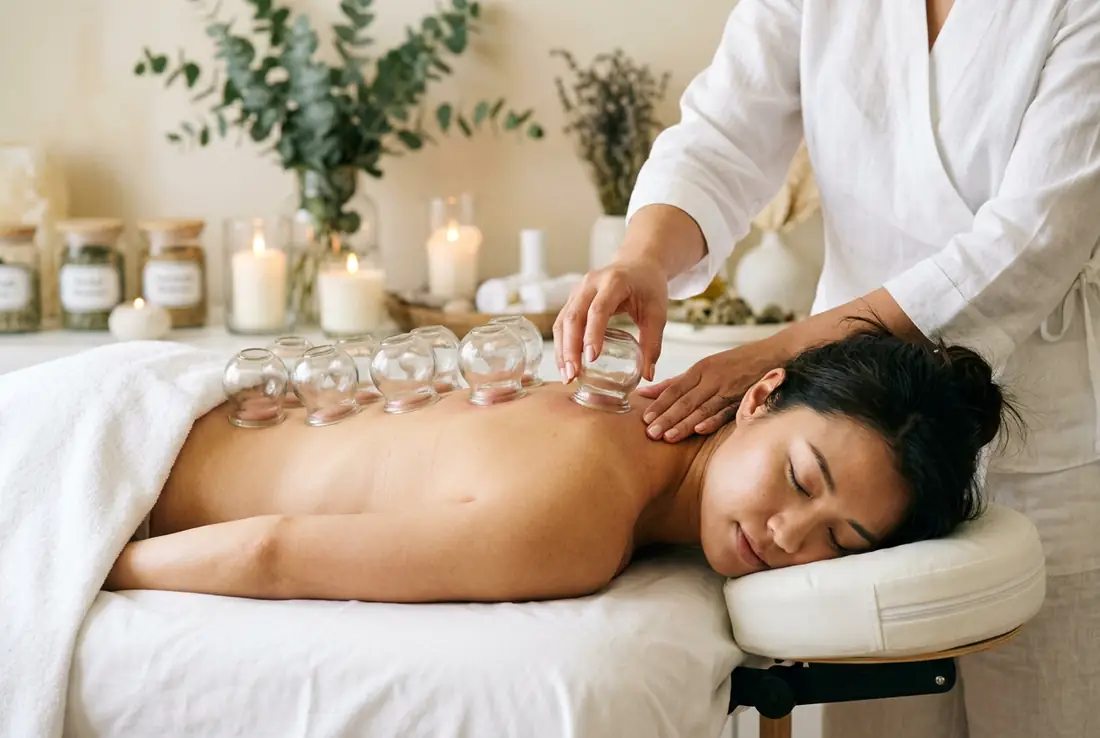
The mechanics are simple, and once the suction makes sense the rest of cupping follows from it. A cup goes on your skin. The air inside is drawn out, the pressure drops, and the skin plus the layer of tissue just underneath lifts up into the cup. That lift is what you feel during the session and what leaves a mark afterward.
Everything else — which cups, where they go, how long they sit, how the session is built around them — is a judgment call your therapist makes with you at intake. Here is how we make those calls.
Suction, not pressure — the opposite of a massage stroke
The easiest way to understand cupping is to picture a massage in reverse. When a therapist massages you, hands and forearms press down into the muscle. Cupping pulls the same tissue up and away from what sits beneath it.
That is why people describe the sensation as a deep stretch from the inside rather than as pressure, and it is why cupping draws a little blood toward the surface. The pull is the whole technique. Every other question about cupping — the feel, the marks, the contraindications — traces back to it.
Dry cupping only — we do not do wet cupping
The single most important distinction in cupping is whether the skin stays intact, and there are only two answers. In dry cupping the skin is never pierced. In wet cupping the skin is deliberately cut so blood flows into the cup.
That gap is larger than the names suggest. Dry cupping leaves a temporary mark. Wet cupping is, by design, a procedure that opens the skin, which moves the conversation from discoloration to an open wound and everything that comes with one. Q Healthy Spa performs dry, non-piercing cupping only. If you ever book cupping anywhere and the provider cannot tell you plainly which one they do, settle that question before anything else.
Cupping or gua sha — how we choose
We also offer gua sha, and the two are close enough cousins that guests often ask which one they want. Both come out of the same traditional tradition, both work the surface tissue rather than pressing into it, and both can leave temporary marks. The difference is the direction of the force: cupping lifts tissue upward with suction, while gua sha strokes a smooth-edged tool along oiled skin.
In practice we pick by area and preference. Cups suit broad, thick zones — the back, the glutes, the thighs — where there is enough tissue for suction to draw up. Gua sha suits places a cup seals poorly or not at all: the neck, along the shoulder ridge, the forearms, the shins. Some sessions use both, and either can be worked into the same deep tissue or therapeutic appointment. Your therapist will talk it through at intake before anything touches your skin.
How a cupping session actually runs
Most guests book cupping as part of a 60- or 90-minute deep tissue or therapeutic massage, and there is a repeatable arc behind it. The cups land in the middle of the session — after the warm-up, before the final hands-on work — so you leave having had a full massage with cupping woven in, not ten minutes of suction billed as recovery.
Where the cups go depends on where you actually hold tension. Desk workers usually want the upper back, neck and shoulders. People carrying low-back and hip tightness lean toward the glutes and lumbar region. We sort that out at intake before anything touches your skin.
The four steps, in order
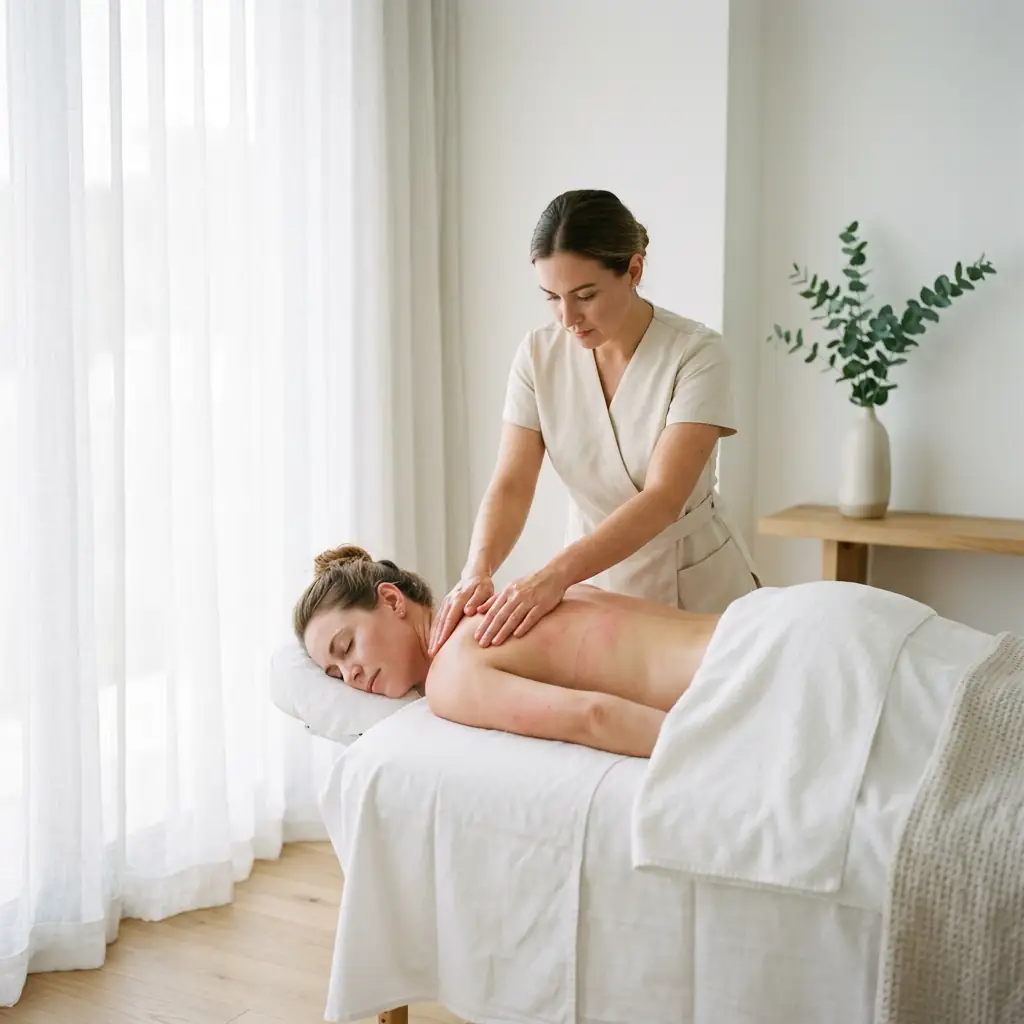
Almost every cupping session at Q Healthy Spa follows the same sequence. None of it is improvised on the spot.
1. Warm up by hand
Ten to fifteen minutes of hands-on massage to bring blood to the area and soften the surface tissue before any cup goes on. Cold, guarded muscle does not respond well to suction, so we never start cold.
2. Decompress with cups
Cups placed on the tightest zones and left to work for a few minutes at a time. This is where you feel the deep-stretch pull, tissue drawn gently up instead of pressed down. Suction is set to your comfort, not to a fixed number, and your therapist checks in while it sits.
3. Integrate by hand
Your therapist comes back by hand and works through everything the cups decompressed, blending it into the rest of the massage so you leave with a finished session rather than a patchwork of round marks.
4. Aftercare at home
Drink some extra water, keep the cupped area warm and covered, and skip the sauna, hot tub and hard workouts for about 24 hours. None of that is medicinal — it just helps you feel your best and keeps fresh marks from showing where you would rather they did not.
How much time to book
Cupping adds roughly 15 to 30 minutes of focused work to a session. On a 60-minute appointment that is workable for one region — an upper back, say. If you have been carrying tension for weeks, book 90 minutes instead of squeezing cups into an hour; one short add-on rarely catches months of buildup.
Because a cupping session takes a therapeutic-massage slot, booking ahead matters — especially evenings and weekends. Call 715-256-8288 and the front desk will tell you what is open this week and quote the exact rate.
Does cupping hurt, and what are the marks?
These two questions come up more than every other cupping question combined, and both have short, honest answers. Cupping should not hurt, and the marks are not what the internet says they are. We go over both at intake and show you exactly where cups would go, so nothing is a surprise.
| Area | Cups per side | Typical fade time | Visible in a t-shirt? |
|---|---|---|---|
| Upper traps / shoulder ridge | 2 to 3 | 3 to 5 days | Sometimes |
| Between the shoulder blades | 3 to 4 | 4 to 6 days | No |
| Along the thoracic spine | 4 to 6 | 4 to 7 days | No |
| Lower back / lumbar | 2 to 4 | 5 to 7 days | No |
| Glutes | 2 to 3 | 5 to 7 days | No |
| Quads / IT band | 3 to 5 | 5 to 7 days | Shorts only |
| Calves | 2 to 3 | 4 to 6 days | Shorts only |
What the pull actually feels like
No, cupping should not hurt. The sensation is firm and unfamiliar the first time, but most guests describe it as a deep, satisfying stretch from inside the muscle — not sharp, not burning. Once a cup settles it becomes a steady, calm tug that eases as the muscle relaxes.
Suction is adjustable, and we keep it at your edge rather than past it. If anything feels too intense your therapist eases the suction or lifts the cup off immediately. There is nothing to grit through and no benefit in doing so.
The marks are pooled blood, not toxins
Plenty of places get this wrong, so here is the correction we give every guest. The round patches are not toxins or metabolic waste being drawn out of your body. When the cup lifts the skin, a few tiny capillaries underneath rupture and a small amount of blood leaks into the surrounding tissue. The flat round patch you see afterward — pink, red, sometimes nearly purple — is the same basic biology as a bruise, produced by negative pressure instead of a knock.
There is no mechanism by which a cup draws toxins through intact skin, and the federal NCCIH cupping fact sheet describes the marks as temporary discoloration rather than a detox event. They look more dramatic than they feel and are usually not tender afterward.
How long they last, and timing around events
Cupping marks typically fade in 3 to 7 days, faster on some areas than others. They clear on their own and need no treatment. NCCIH also notes that persistent discoloration and scarring have been reported, which is one more reason we keep the suction moderate rather than chasing dark marks.
We talk through placement before we start, so if you have a wedding, a photoshoot or a beach weekend on the calendar we can stay off visible areas or skip cupping that visit. If timing matters for photos, book 7 to 10 days ahead and wear something loose and darker for the first day.
Who cupping suits — and who should skip it
Cupping suits curious, generally healthy people who are sore but not injured. It is not appropriate for everyone, and a short list of conditions are real reasons to skip it. We sort out which group you are in at intake, and we would rather decline a booking than cup someone who should not have it.
Who books cupping at our Eau Claire spa
The common thread is ordinary tension or soreness rather than injury. Desk workers come in with weeks of tightness through the traps, neck and mid-back that hands-on work reaches but does not quite finish. Runners and lifters use it between hard efforts to feel looser. And a steady stream of first-timers simply want to try cupping once with someone who will give them a straight answer.
If any of those is you, pair cupping with deep tissue rather than booking it alone — the massage is what carries the session.
Who should not get cupping
Suction breaks tiny surface vessels by design, so anything that affects bleeding, skin integrity or healing changes the risk picture. Tell us your medications and conditions at intake, and check with your own physician when you are unsure.
Separate from the list below, one rule holds for everyone: never put cups over a fresh injury, and never let cupping delay real care. A strain, a sprain or an illness needs a medical provider, not a cup.
Blood thinners and bleeding disorders
On a blood thinner, or living with a bleeding or clotting disorder? Cupping waits until your physician clears it. Because the suction is meant to rupture small vessels, anything that raises bleeding deepens both the marks and the risk.
Fragile, broken or infected skin
We need intact, healthy skin under the cup. Anywhere fragile, broken, infected or carrying an open wound is off-limits — we route around it or hold off entirely that day.
Eczema or psoriasis flares
NCCIH lists worsening eczema and psoriasis among cupping's documented side effects, so cups stay clear of any flaring patch. Flag a skin condition at intake and we plan around it.
Pregnancy, the scalp, and fresh injuries
If you are pregnant, tell us and clear it with your provider first — some placements are not appropriate. We do not cup the scalp at all: bleeding inside the skull has been reported after scalp cupping, and it is a rare risk with no upside worth taking. And a fresh strain or sprain needs assessment and rest, never suction.
Sanitation between every guest
Cups are cleaned between every client, without exception. That is not an upsell line. NCCIH is explicit that cupping equipment can pick up trace blood — intentionally in wet cupping, inadvertently in dry — and that reusing it without sterilizing between people can spread bloodborne illness such as hepatitis B and C. Note that dry cupping is on that list too. Whichever spa you choose, ask the question.
How often to come back
Cupping is not a course of treatment, so there is no prescribed number of sessions. What there is, is a sensible interval by what you are actually chasing — and a point past which you are just buying marks.
| Goal | Interval | Sessions before reassessing | Session length |
|---|---|---|---|
| Curious, trying it once | One-off | 1 | 60 minutes |
| Desk tension that returns weekly | Every 2 to 3 weeks | 3 | 60 minutes |
| Months of accumulated tightness | Every 1 to 2 weeks at first | 4 | 90 minutes |
| Between hard training blocks | Every 2 to 4 weeks | 3 | 90 minutes |
| General maintenance | Every 3 to 4 weeks | Ongoing | 60 or 90 minutes |
| More than once a week | Not recommended | 0 | Marks need 3 to 7 days |
Booking cupping therapy in Eau Claire
Cupping is priced by session length and by whether it rides inside a massage or runs as focused work, plus whatever seasonal specials are live, so the accurate quote comes from a quick phone call rather than a price grid that goes stale.
Rates, hours and how to book
Call 715-256-8288 for current cupping rates and to book. We are open every day from 9:00 AM to 9:30 PM, walk-ins are welcome when a therapist is free, and appointments are strongly preferred for cupping because it needs a therapeutic slot. First-time guests get $5 off, and every session includes complimentary hot stone therapy and sauna access.
If you would rather write than call, the contact page has our email and a map. Tell us where you are tight and whether you have had cupping before — that is most of what we need to plan the session.
Where to find us
Q Healthy Spa is at 2151 Eastridge Center, Floor 1, #C, Eau Claire, WI 54701 — inside the Eastridge Center on the east side of town, with parking right outside and no stairs. We are an easy drive from the UW-Eau Claire campus, Altoona and the Highway 53 corridor.
Coming from out of town? Chippewa Falls is about fifteen minutes away, and we see Chippewa Falls guests regularly.
Where our cupping claims come from
The cautious framing on this page is not our house opinion; it comes from the federal research agency. The National Center for Complementary and Integrative Health publishes a cupping fact sheet that lists no conditions cupping treats and cites no trial showing it works. Most of the page is about safety. We lean on it deliberately so the claims here are attributable rather than something a spa simply asserts.
NCCIH is part of the National Institutes of Health, and its material is general education rather than medical advice. If you take medication, are pregnant, have a skin condition, or bruise or bleed easily, talk it through with your own clinician before trying cupping — and see a medical provider for any actual injury or illness.
How to Book a Massage at Q Healthy Spa
Booking takes about 2 minutes and there is no online form to fill in. Call 715-256-8288 any day between 9:00 AM and 9:30 PM, say which service and length you want, and the session is held under your first name. Walk-ins are taken when a table is free, which on weekday afternoons is most of the time.
- Call 715-256-8288. Someone answers the phone during all 12.5 open hours, 7 days a week — there is no booking app and no deposit.
- Pick a length: 60 minutes for a full body session, 90 minutes for unhurried work on the back and shoulders, or 120 minutes when you want both.
- Pick a pressure: light, medium, or firm. You can change it mid-session at any point, and saying so does not offend anyone.
- Mention add-ons at booking. Cupping and gua sha are added to a 60 or 90 minute session and need a few extra minutes set aside.
- Arrive 5 to 10 minutes early at 2151 Eastridge Center, Floor 1, Suite C. Parking is free and the entrance is on the ground floor.
- Tell the therapist what hurts and what to avoid before the session starts. This 60-second conversation is what makes the other 59 minutes useful.
- Pay by cash or card at the end. First-time visitors get $5 off, and no appointment is needed to claim it.
| Detail | Number | Notes |
|---|---|---|
| Days open per week | 7 | Including most holidays |
| Hours open per day | 12.5 | 9:00 AM to 9:30 PM |
| Last session start | 8:30 PM | For a 60 minute session |
| Session lengths | 60, 90, 120 minutes | Same 4 styles at every length |
| Massage styles | 4 | Futon, Swedish, deep tissue, therapeutic |
| Add-ons available | 2 | Cupping and gua sha, inside a 60 or 90 minute session |
| First-visit discount | $5 | Every new client, no coupon needed |
| Included at no extra charge | 2 | Hot stone therapy and sauna access |
| Google rating | 5.0 stars | 16 reviews |
| Assisted stretches in a futon session | 15 to 25 | Fully clothed, no oil |
| Cupping marks fade in | 3 to 7 days | Dry cupping only, never wet |
| Arrive before your session | 10 minutes | 5 minute intake, 3 to 5 to change |
| Drive from downtown Eau Claire | 7 minutes | 2.5 miles |
| Drive from Chippewa Falls | 15 minutes | 11 miles via Highway 124 |
| Notice for a Saturday booking | 3 to 7 days | Weekday mornings often same day |
Sources
- NCCIH — CuppingThe federal fact sheet on cupping: no conditions it treats, the marks, and the documented safety risks.
- NCCIH — Massage Therapy: What You Need To KnowThe federal complementary-health agency's overview of what massage is and what the research does and does not support.
- Wisconsin DSPS — Massage Therapy & Bodywork licensingThe state board that licenses massage therapists in Wisconsin.
Frequently Asked Questions
Does cupping therapy hurt?
No, cupping should not hurt. Most guests describe it as a firm, deep stretch from inside the muscle — unusual the first time, but not sharp or burning. Your therapist sets the suction at your comfort and eases or removes a cup the moment anything feels too intense.
What are the round cupping marks — are they bruises or toxins?
They are not toxins. Cupping marks are pooled blood from tiny ruptured capillaries, the same basic biology as a bruise, produced by suction instead of impact. When the cup lifts the skin, small vessels just beneath it rupture and a little blood leaks into the surrounding tissue, leaving a flat round patch. There is no mechanism by which a cup pulls toxins through intact skin. The marks usually fade in 3 to 7 days and are typically not tender.
Do you offer cupping therapy in Eau Claire?
Yes. Q Healthy Spa offers dry, non-piercing cupping at 2151 Eastridge Center in Eau Claire, most often as part of a 60- or 90-minute deep tissue or therapeutic massage. Call 715-256-8288 to check therapist availability and current rates. We are open daily from 9:00 AM to 9:30 PM.
Do you offer gua sha as well as cupping?
Yes. Gua sha comes from the same tradition and works the same surface tissue, but instead of lifting it with suction your therapist strokes a smooth-edged tool along oiled skin. It reaches areas where a cup seals poorly — the neck, the shoulder ridge, the forearms and shins — so the two are often used in the same appointment. Like cupping, gua sha can leave temporary marks, follows the same contraindications, and is a traditional comfort practice rather than a medical treatment. Mention it when you book at 715-256-8288 and we will plan the session around both.
Is your cupping dry or wet cupping?
Dry, non-piercing cupping only. Dry cupping does not break the skin. Wet cupping deliberately cuts the skin so blood flows into the cup, which carries much heavier risks including bloodborne infection, scarring and, with repetition, blood loss. We do not offer wet cupping and never will. Cups are cleaned between every guest.
Can I add cupping to a deep tissue or therapeutic massage?
Yes, and that is how most guests book it. Your therapist warms the tissue by hand for the first ten to fifteen minutes, decompresses the tight spots with cups, then returns by hand to integrate the work into the rest of the massage. The hands-on massage carries the appointment; the cups are one step inside it. Cupping typically adds 15 to 30 minutes of focused work.
How much does cupping cost at Q Healthy Spa?
Pricing depends on session length and on whether cupping is added to a massage or booked as focused work, plus any current specials, so call 715-256-8288 for an exact quote. First-time guests receive $5 off, and every session includes complimentary hot stone therapy and sauna access at no extra charge.
Who should not get cupping?
Skip cupping — or clear it with your physician first — if you take blood thinners or have a bleeding or clotting disorder, have fragile or broken skin, have an active skin infection or open wound where cups would go, or have eczema or psoriasis flaring in that area, since cupping can worsen both. Some placements are not appropriate during pregnancy. We do not cup the scalp. Never put cups over a fresh injury, and never let cupping delay real medical care.
Does cupping actually work, or is it hype?
Honestly, the high-quality evidence is largely missing. The NCCIH cupping fact sheet, from the federal agency that studies practices like this, lists no conditions cupping treats and cites no trials showing it works — most of the page is about safety. We treat cupping as a low-evidence traditional comfort practice that complements massage, rest, hydration and sleep, not as a medical treatment. Many guests find a session leaves them looser and more relaxed, which is a real experience and a fine reason to book it, but it is not a proven physiological effect and we keep that distinction clear.
What should I do after a cupping session?
Drink some extra water for the rest of the day, keep the cupped area warm and covered, and skip the sauna, hot tub and hard workouts for about 24 hours. The marks need no special treatment and fade on their own in 3 to 7 days. If you have an event coming up, book at least 7 to 10 days ahead or ask us to stay off visible areas that visit.
Book Cupping Therapy in Eau Claire
Tell us where you are tight and whether you have had cupping before — that is most of what we need. Open daily 9:00 AM to 9:30 PM, with free hot stone therapy and sauna access included.
Keep Reading
Every page below covers a different angle — technique, pairing, evidence, or the rest of the menu at Q Healthy Spa.